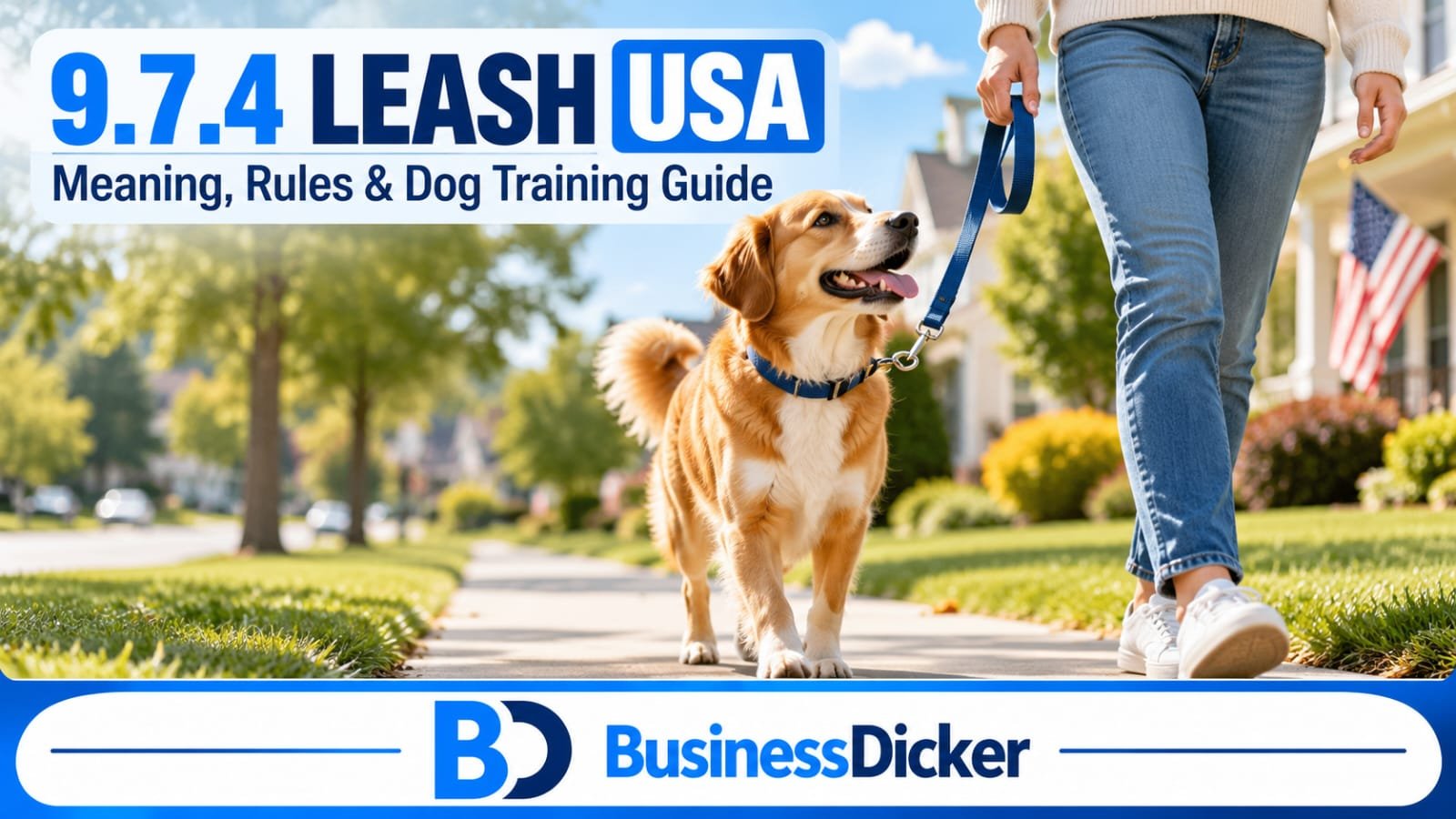

If you have searched for 9.7.4 leash USA, you may be trying to understand a dog leash rule, an obedience competition requirement, or a specific reference found online. The term is unusual, so it is important to separate the meaning of the keyword from the official rules that dog owners and competitors must follow.
In the United States, dog leash requirements can vary by location, public space, and type of activity. Competitive obedience also has its own equipment and handling rules. Understanding the difference helps dog owners choose appropriate equipment, train their dogs safely, and avoid relying on incorrect information.
This guide explains what the term may refer to, what official American Kennel Club (AKC) rules say about leashes, and how to handle a dog leash correctly during everyday walks and obedience training.
What Is 9.7.4 Leash USA?
The phrase 9.7.4 leash USA appears to refer to a numbered leash rule or a dog-obedience regulation. However, the exact meaning cannot be confirmed from the keyword alone.
The American Kennel Club publishes official obedience regulations that cover leash use, collars, heel position, and individual competition exercises. Its published regulations include a section titled “Use of Leash,” but the reference should not automatically be interpreted as an official AKC rule numbered 9.7.4.
Readers should check the original document or organization associated with the number before treating it as an official requirement.
A leash is a strap, cord, or similar piece of equipment attached to a dog’s collar or harness. It helps the handler guide the dog, maintain control, and reduce the risk of unsafe movement in public spaces.
For dog owners, the practical questions are straightforward: Which leash is appropriate? How should it be held? When must a dog remain on a leash? And what changes when the dog participates in an organized obedience trial?
Is 9.7.4 an Official Dog Leash Rule in the USA?
The number alone does not establish that a rule is official. To verify a regulation, identify the organization that issued it and consult its current rulebook.
The American Kennel Club provides an official set of obedience regulations for competitors, judges, and dog handlers. These regulations describe equipment requirements and procedures for different obedience exercises.
For example, the AKC’s leash provisions state that dogs generally must remain on a leash outside the designated obedience ring or exercise area, subject to the applicable competition rules. Its regulations also specify a six-foot leash for the Beginner Novice Sit for Exam exercise and the Novice Group Exercise involving Sit and Down Stay.
These requirements apply to the specified competition exercises. They should not be presented as a universal leash-length requirement for every dog in the United States.
If you found the phrase 9.7.4 leash in an online article, a training document, or a competition handout, check its original source before relying on it. A numbered reference may belong to a particular document rather than a nationwide rule.
Understanding Dog Leash Rules in the United States
Dog leash rules are not identical across the country. State laws, city ordinances, park regulations, and private property policies may impose different requirements.
Before taking your dog to a public place, check the rules that apply to that location.
Local Leash Laws
Many public areas require dogs to remain on a leash unless the location specifically permits off-leash activity. The exact requirements depend on the relevant local authority.
For example, a city sidewalk, a public beach, a hiking trail, and a designated dog park may have different rules. Some places require a fixed-length leash, while others may permit additional options under certain conditions.
Dog owners should check the official city, county, or park website for current requirements. Do not assume that a rule in one state or city applies throughout the United States.
Leash Requirements at Dog Competitions
Dog obedience competitions follow the rules of their organizing body. The AKC’s obedience regulations specify when dogs must enter and leave the ring on a leash, which equipment is permitted, and how certain exercises must be performed.
Competitors should review the current regulations for their specific class rather than rely on a general online summary.
Leash Rules on Private Property
Private properties, apartment communities, residential developments, and commercial establishments may set their own dog-handling policies, subject to applicable law.
Owners should check the property’s requirements before allowing a dog to move around shared spaces. Keeping a leash available is a sensible precaution even when a location appears quiet.
Which Type of Dog Leash Should You Choose?
The best leash depends on the dog’s size, strength, training level, and intended activity. A leash that works well for a calm adult dog may be unsuitable for a strong dog that pulls or a puppy that is still learning to walk.
Standard Fixed-Length Leash
A standard fixed-length leash is a practical choice for daily walks and basic training. It provides a predictable amount of space between the dog and handler.
A six-foot leash is also specified for certain AKC obedience exercises, including Beginner Novice Sit for Exam. However, owners should not assume that this length is mandatory in every public area.
Rope Leash
Rope leashes can provide a comfortable grip and are available in different thicknesses and lengths. They may suit everyday walking, depending on their construction and the dog’s behavior.
Choose a rope leash with secure hardware and a suitable diameter. A very thin rope can become uncomfortable to hold when a strong dog pulls.
Short Traffic Leash
A short leash can help maintain closer control near roads, in crowded areas, or when passing other people and animals.
It should still allow the dog to move comfortably without constant pressure on its neck. If the dog pulls strongly, consider suitable harness equipment and structured training rather than relying only on a shorter leash.
Long-Line Training Leash
A long line allows a dog more room to explore while remaining connected to the handler. It can be useful for recall practice in an appropriate open area.
Long lines require extra care. Keep them away from roads, bicycles, and crowded paths. Avoid allowing the line to wrap around your hands, legs, or the dog’s body.
Retractable Leash
A retractable leash provides adjustable distance, but it can make close control harder in busy environments. Its thin cord may also create a risk of cuts, burns, or entanglement.
For puppies, dogs that pull, and walks near traffic, a standard fixed-length leash is often easier to manage. Choose equipment based on safety and control rather than convenience alone.
How to Handle a Dog Leash Correctly
Good leash handling makes walks more predictable and helps prevent sudden movements from becoming dangerous. It also gives the dog a clearer understanding of the behavior you expect.
1. Check the Equipment Before Walking
Inspect the leash, clips, stitching, and attachment points before leaving home. Replace equipment that shows signs of damage.
Make sure the collar or harness fits correctly. The leash should attach securely without placing unnecessary pressure on the dog’s neck or body.
2. Hold the Leash Securely
Keep a comfortable grip and enough slack for normal movement. Avoid wrapping the leash tightly around your fingers, wrist, or arm because a sudden pull can cause injury.
Your grip should allow you to respond calmly if the dog changes direction.
3. Reward Loose-Leash Walking
Start in a quiet area with few distractions. Reward your dog when it walks beside you without pulling.
If the leash becomes tight, stop moving and wait for the dog to release the tension. Resume walking when the leash loosens. Consistent practice helps the dog learn that pulling does not produce forward movement.
4. Maintain a Safe Distance From Other Dogs
Not every dog wants to greet unfamiliar animals. Watch body language and give other dogs enough room to pass.
Do not force an interaction simply because both dogs are on leashes. If either animal appears frightened, tense, or overly excited, calmly increase the distance.
5. Practice Basic Commands
Commands such as “sit,” “stay,” “come,” and “heel” can make walks easier to manage. Teach each behavior in a low-distraction environment before practicing in busier places.
Reward the behavior you want to see. Avoid sudden leash jerks or using the leash to force a dog into position.
What Is the Sit for Examination Exercise?
The Sit for Exam exercise is part of the AKC Beginner Novice obedience class. It tests whether a dog can remain seated while a judge approaches and examines the dog.
The exercise is useful because dogs may need to tolerate gentle handling in everyday situations, including veterinary visits and grooming appointments.
According to the AKC’s published class guidance, the handler holds the leash and moves approximately six feet away while the dog remains seated for the examination.
The exercise is not simply about holding a leash. It also tests the dog’s ability to remain calm, stay in position, and accept the judge’s approach.
How to Practice Sit for Examination at Home
Begin with short sessions in a familiar environment.
- Ask your dog to sit and reward it for remaining in position.
- Take a small step away and return before the dog gets up.
- Gradually increase the distance while rewarding calm behavior.
- Ask a familiar person to approach slowly while you supervise the dog.
- End the session if the dog becomes distressed, and resume at an easier level.
Never force a fearful dog to tolerate handling. If your dog growls, snaps, or shows persistent fear around unfamiliar people, seek guidance from a qualified, reward-based trainer or veterinary behavior professional.
For competition, use the exact instructions in the current rulebook. Home practice is helpful, but it does not replace the official exercise requirements.
Common Dog Leash Mistakes to Avoid
Even a suitable leash can become difficult to manage when the handler uses it incorrectly.
Choosing Equipment That Does Not Suit the Dog
A small, lightweight leash may not be suitable for a strong dog. Likewise, heavy equipment may be uncomfortable for a small puppy.
Choose a leash and attachment system that fit the dog’s size, behavior, and activity.
Pulling Back Every Time the Dog Pulls
Repeatedly pulling against a dog can create a cycle of tension. It may also make the walk more stressful.
Instead, practice stopping when the leash becomes tight and rewarding the dog when it returns to a comfortable walking position.
Giving Too Much Freedom Near Traffic
A long or extended leash can make it difficult to prevent a dog from reaching a road or approaching a stranger unexpectedly.
Use closer control in busy places. Save long-line exercises for suitable areas where you can maintain a safe distance from hazards.
Ignoring the Rules of a Specific Location
A leash permitted on one trail may not be accepted in another park or competition.
Check the current rules before visiting a new location. If you are entering a formal obedience trial, read the applicable regulations rather than relying on advice intended for casual walks.
How to Verify Dog Leash Regulations
If your main concern is whether 9.7.4 leash is a genuine rule, follow these steps before accepting information from an online article.
Step 1: Identify the issuing organization. Find out whether the number comes from the AKC, another kennel club, a local authority, or a private training program.
Step 2: Find the original document. Look for the official rulebook, ordinance, or competition instructions rather than relying solely on a third-party summary.
Step 3: Check the section heading. Confirm that the number refers to leash use and not to an unrelated exercise or a different topic.
Step 4: Review the latest version. Rules can change, so verify the publication date or current edition.
Step 5: Confirm the scope. Determine whether the rule applies to a particular competition class, a public location, or a broader category of activity.
For official AKC competition information, visit the AKC obedience judging resources. For general class information, see the AKC obedience classes guide.
Frequently Asked Questions About 9.7.4 Leash USA
What does 9.7.4 leash USA mean?
It appears to be a search term referring to a numbered dog leash rule or obedience regulation. Its precise meaning cannot be confirmed without the original source. The number should not be treated as an official nationwide requirement without verification.
Is 9.7.4 an official AKC leash regulation?
The number alone does not establish that it is an official AKC regulation. The AKC publishes detailed obedience rules, including a section on leash use. Consult its current rulebook to verify the applicable provision.
What leash length does the AKC require?
The AKC’s published obedience regulations specify a six-foot leash for the Beginner Novice Sit for Exam and the Novice Group Exercise involving Sit and Down Stay. Other exercises may have different requirements, so competitors should consult the rules for their specific class.
Do all dogs in the USA have to wear a leash in public?
There is no single leash-length or leash-use rule that applies identically to every public location. Requirements depend on applicable laws and local rules. Check the official regulations for the city, county, park, or property you plan to visit.
Can I use a retractable leash for dog training?
A retractable leash may suit some low-risk situations, but it can make close control more difficult. A standard fixed-length leash is often a more practical choice for basic training and walking near traffic.
How can I teach my dog to stop pulling?
Practice in a quiet area, reward loose-leash walking, and stop when the leash becomes tight. Resume when your dog releases the tension. Keep sessions short and gradually introduce more distractions.
Is leash handling important in obedience competitions?
Yes. Handlers must follow the equipment and exercise requirements of the organization hosting the trial. Proper handling supports safe movement and helps the team perform according to the applicable rules.
Where can I find official dog obedience rules?
The American Kennel Club provides official regulations and judging resources on its website. Start with its obedience judging information and review the current rules for your competition class.
Final Thoughts
Searching for 9.7.4 leash USA may lead you to information about dog leash handling and obedience competition rules, but the exact numbered reference needs verification. It is better to confirm the original document than to assume that every online explanation describes an official rule.
For everyday dog owners, the priorities are straightforward: choose suitable equipment, maintain safe control, teach loose-leash walking, and follow the rules of the location you visit. For obedience competitors, use the current regulations issued by the relevant organization.
These steps provide a more reliable foundation for safe walks, effective training, and confident participation in dog obedience activities.
Read more about on Business dicker