
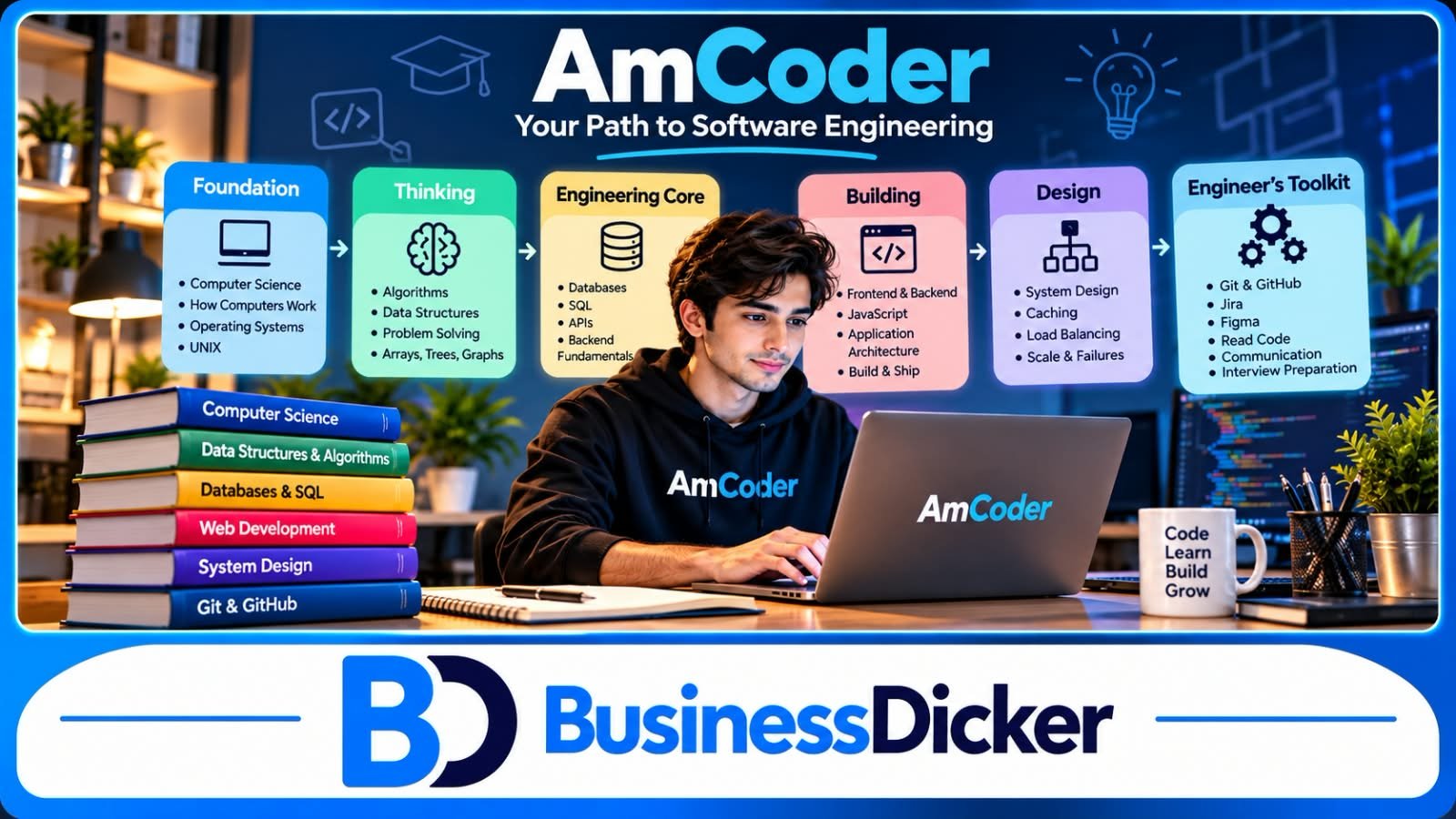

Learning software engineering can feel confusing when you have too many things to learn and no clear order to follow. You may find tutorials about programming, DSA, databases, web development, AI, Git, and system design, but knowing where to start can still be difficult.
AmCoder takes a structured approach to this problem. Its official website presents AmCoder as a learning path toward becoming a software engineer, starting with computer science fundamentals and gradually moving toward problem solving, software development, system design, and professional engineering tools.
The idea is simple: understand the basics first, then build on them as you move into more advanced areas of software engineering.
What Is AmCoder?
AmCoder is a software engineering learning platform focused on helping learners understand how computer science and software development fit together.
Instead of presenting coding as a list of unrelated topics, AmCoder organizes its learning journey into several stages. These include Foundation, Thinking, Engineering Core, Building, Design, and Engineer’s Toolkit.
The platform starts with basic computer science concepts and then moves toward algorithms, data structures, databases, APIs, frontend and backend development, system design, and tools used by software teams.
This approach can be useful for learners who know some programming but still struggle to understand how different parts of software engineering connect.
AmCoder Learning Path
The AmCoder roadmap is divided into six main areas. Each section focuses on a different part of the journey toward becoming a software engineer.
1. Foundation
The Foundation stage introduces the basic ideas behind computer science.
It covers topics such as how computing developed, what computation means, how hardware and software work together, why operating systems exist, and how UNIX influenced modern computing.
The roadmap also covers instructions, memory, and processes. These concepts help learners understand what happens inside a computer instead of only focusing on the code they write.
2. Thinking
The Thinking stage focuses on problem solving.
AmCoder introduces algorithms and data structures as tools that help developers solve problems. The published roadmap includes arrays, stacks, queues, trees, and graphs.
It also focuses on time and space considerations. This helps learners think about not only whether a solution works, but also how efficiently it works.
This part of the learning path is especially important because software development involves making decisions. A developer needs to understand the problem first and then choose an appropriate way to solve it.
3. Engineering Core
After the fundamentals and problem-solving stage, AmCoder moves into core software engineering concepts.
This section includes memory and disk, relational databases, database schemas, SQL, APIs, backend fundamentals, and server-side thinking. It also looks at why software systems can fail and how engineers can design systems with those problems in mind.
These concepts connect programming with the systems that support real applications.
For example, an application does not simply run code. It stores information, communicates with other services, sends and receives requests, and depends on different parts working together.
Understanding these connections can make software development easier to approach.
4. Building
The Building stage moves closer to application development.
AmCoder covers frontend and backend development, browsers, JavaScript, application architecture, communication between different parts of an application, and the process of planning and shipping features.
At this stage, learners can begin to see how individual programming concepts become complete applications.
Frontend development deals with what users interact with, while backend development handles services, data, and other operations behind the interface. Understanding how these parts communicate is an important part of modern web development.
5. Design
The Design stage introduces system design.
AmCoder’s roadmap includes both low-level and high-level system design. It also covers concepts such as caching, load balancers, traffic, scale, failures, responsibilities, and system boundaries.
System design becomes increasingly important as software grows.
A small application may work with a simple structure, but larger systems need to handle more users, more requests, more data, and more possible failures. Developers therefore need to think about how different components work together.
AmCoder places these concepts after its foundation, problem-solving, engineering, and application-building stages.
6. Engineer’s Toolkit
The final part of the published roadmap focuses on the tools and skills developers use while working with others.
AmCoder mentions Git and GitHub, Jira, Figma, reading other people’s code, communication, and interview preparation.
This section shows that the learning path is not limited to writing code.
Software engineering also involves collaboration, planning, reviewing existing code, communicating ideas, and working with tools used by development teams.
Why Does AmCoder Start With Fundamentals?
One of the main ideas behind AmCoder is that learners should understand concepts before they simply memorize them.
A beginner can learn programming syntax quickly, but syntax alone does not explain how software works as a complete system.
For example, knowing how to write a function does not automatically explain how memory works, how a database stores information, how an API communicates with another service, or why a system might need caching.
AmCoder therefore starts with computer science and problem-solving concepts before moving into broader software engineering topics.
AmCoder FAQs
What is AmCoder?
AmCoder is a software engineering learning platform that provides a structured path from computer science fundamentals to problem solving, software development, system design, and professional engineering tools.
What does AmCoder teach?
AmCoder covers computer science, algorithms, data structures, databases, SQL, APIs, frontend and backend development, JavaScript, system design, caching, load balancing, Git, GitHub, Jira, Figma, code reading, communication, and interview preparation.
Is AmCoder good for beginners?
AmCoder starts with computer science foundations before moving into more advanced software engineering topics. This structured approach can make it suitable for learners who want to build their understanding step by step.
Does AmCoder teach data structures and algorithms?
Yes. The Thinking stage of the AmCoder roadmap covers algorithms, data structures, problem solving, and time and space considerations. It specifically includes structures such as arrays, stacks, queues, trees, and graphs.
Does AmCoder cover system design?
Yes. The Design stage covers low-level design, high-level system design, caching, load balancing, traffic, scale, failures, and system boundaries.
Does AmCoder cover frontend and backend development?
Yes. The Building stage covers frontend and backend development, browsers, JavaScript, application architecture, communication between application components, and feature development.
Does AmCoder teach Git and GitHub?
Yes. Git and GitHub are included in AmCoder’s Engineer’s Toolkit section, along with Jira, Figma, code reading, communication, and interview preparation.
What is the main idea behind AmCoder?
The main idea is to give learners a clear path through software engineering. Instead of treating every programming topic as a separate subject, AmCoder connects computer science fundamentals with problem solving, engineering, application development, system design, and professional tools.
Final Thoughts
AmCoder takes a structured approach to software engineering education.
Its learning path begins with computer science fundamentals and gradually moves through problem solving, data structures, databases, APIs, application development, system design, and professional engineering tools.
The biggest focus is not simply learning more technologies. It is understanding how the different parts of software engineering fit together.
For learners who feel overwhelmed by the number of programming topics available today, a clear progression can make the journey easier to follow. AmCoder’s published roadmap provides that progression, moving from the foundations of computing toward the broader skills needed to understand and build software systems.
Explore More:
